Storydoc vs. Beautiful AI

Beautiful.ai is great for making simple things look good fast - especially when you’re building classic slide decks.

But when it comes to professional business documents that drive real results (more leads, more demos, more deals), “nice slides” isn’t enough.

You need a Beautiful.ai alternative built for performance - with conversion mechanics, funnel-ready formats, and engagement signals you can actually act on.

You need…
Storydoc.

Storydoc vs. Beautiful AI

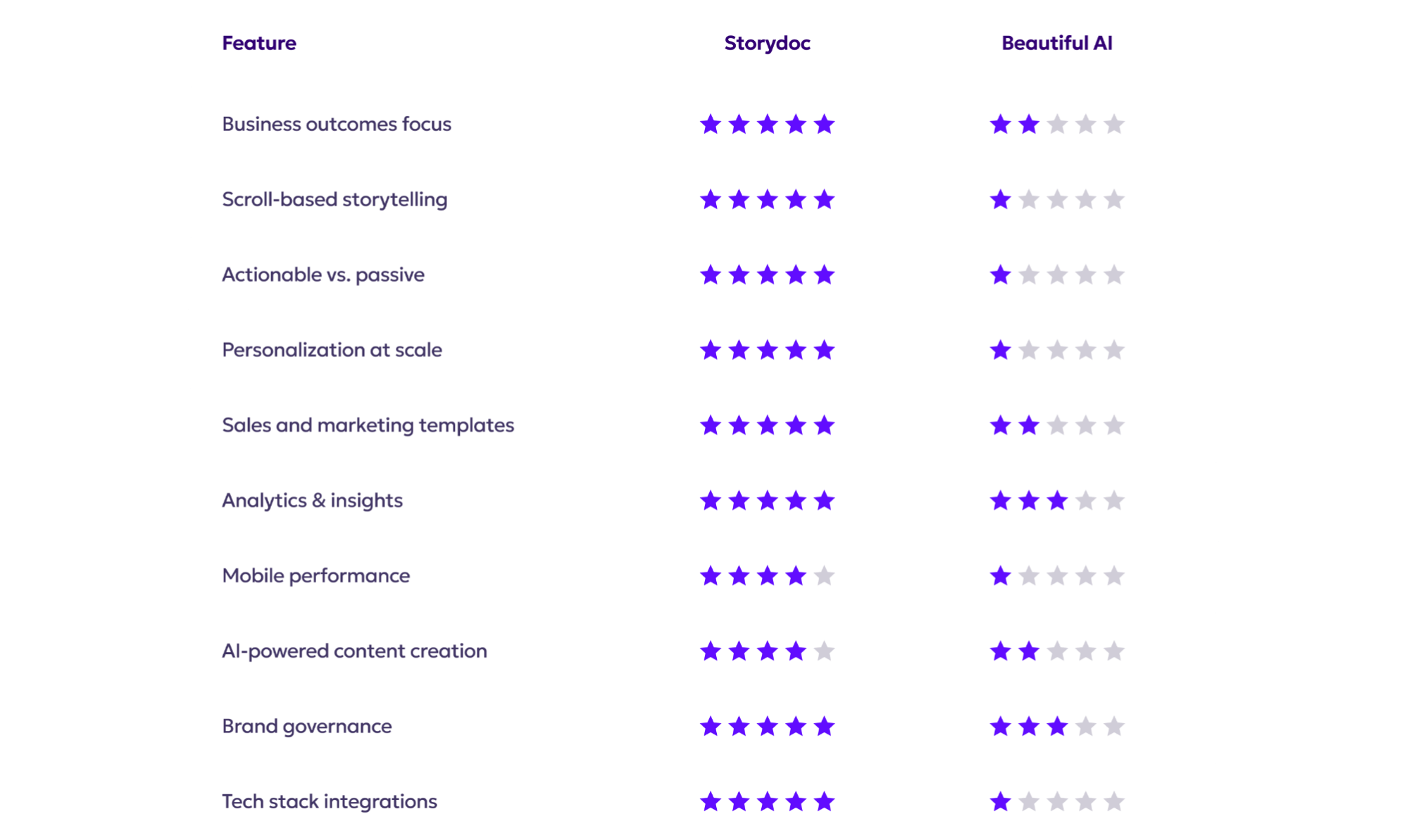
Quick comparison guide

Storydoc vs. Beautiful AI

Built for business outcomes

Storydoc vs. Beautiful AI

Designed to drive leads, pipeline, and revenue with interactive layouts and built-in conversion tools

Every component and template is based on insights from 1.3 million+ real sessions, so the content is structurally optimized to drive buyer action

Supports full B2B sales workflows - from lead-gen to signed deals - with CRM-connected creation, personalization, and tracking

Storydoc vs. Beautiful AI

Great for creating presentations quickly, but output is static - there are no interactive or conversion-ready components

Not built for end-to-end sales workflows: no native personalization at scale, CRM integration is limited, and there are no built-in follow-up triggers

Useful for creating basic presentations or for internal comms, not for driving business growth

Storydoc vs. Beautiful AI

Scroll-based storytelling

Storydoc vs. Beautiful AI

Built around smooth, website-like scrolling - the buyer reads it like a modern web page, not a slide queue

Lets you reveal depth without dumping everything at once (tabs, guided layouts, progressive structure), so the story lands first

Made for async selling: when the rep isn’t there, the document still guides the buyer toward understanding and action

Storydoc vs. Beautiful AI

Primarily click-through slides - the buyer advances one slide at a time, which often breaks the flow and reduces engagement

Great for live presenting, but less natural for self-guided reading the way buyers consume decks today

You can make it look sleek, but it still behaves like a modernized PPT-style deck

Storydoc vs. Beautiful AI

Actionable vs. passive

Storydoc vs. Beautiful AI

Native CTAs, calendars, and forms to push users to the next step

Built for closing too: terms & conditions, e-signatures, and payment modules can live inside the deck

Proven to reduce drop-offs and increase closing times by 30%

Storydoc vs. Beautiful AI

Supports links and buttons, so you have to leave the deck to complete the action

Requires follow-up outside the deck (email/call) to convert leads

No native e-signature or payment modules inside the presentation

Storydoc vs. Beautiful AI

Personalization at scale

Storydoc vs. Beautiful AI

Lets you create ultra-personalized decks in a few clicks using CRM data or spreadsheets - no need to duplicate and edit manually

You can send personalized decks at scale with no recipient limits, making it easy to run large outbound or ABM campaigns

Depending on the level of personalization, engagement can increase by up to 47%

Storydoc vs. Beautiful AI

Manual personalization only - each deck edited by hand for each prospect

No dynamic CRM field integration or smart variables to auto-fill content

Not scalable for large outreach campaigns (slow and error-prone)

Storydoc vs. Beautiful AI

Tailored for sales & marketing

Storydoc vs. Beautiful AI

Built specifically for sales and marketing content: pitch decks, demos, one-pagers, proposals, reports, and more - all in one place

Templates follow proven B2B storytelling structures, helping reps focus on the message instead of reinventing the format

Comes with interactive elements like forms, calendars, and e-signatures, and connects seamlessly with your existing sales tools

Storydoc vs. Beautiful AI

Offers pitch and sales templates, but they’re mostly static slides with smart design - not conversion-ready sales tools

No built-in guidance on narrative structure - users start from scratch

Lacks true sales components like lead capture, smart CTAs, or CRM-connected workflows - it’s visual, but not built to close

Storydoc vs. Beautiful AI

Performance tracking & insights

Storydoc vs. Beautiful AI

Deep engagement analytics: see who viewed, what they clicked, how much time they spent on each slide, or where they dropped off

Real-time alerts let reps follow up while interest is still high

Helps you understand what’s working (and what’s not) and use those insights to improve future decks

Storydoc vs. Beautiful AI

Offers helpful metrics like total views, unique views, average time spent, and completion rate

You can also see who viewed a deck, how long they spent, and how much they consumed - useful for basic follow-up

However, analytics won’t work if Loop Playback is enabled - easy to miss, which can result in lost insights

Storydoc vs. Beautiful AI

Mobile performance

Storydoc vs. Beautiful AI

Built to be properly mobile-responsive and scroll-friendly - no need to pinch and zoom

Designed for modern buyer behavior (a big chunk of outreach opens happen on mobile), so the deck stays readable on any device

Keeps CTAs and next steps usable on smaller screens - which is where deals often move forward

Storydoc vs. Beautiful AI

You can share and view decks via link, but it’s still a slide-based format, which is hard to navigate

Requires zooming and manual resizing, which is a total nightmare for busy clients

Better for viewing a presentation than completing sales actions inside the document

Storydoc vs. Beautiful AI

AI-powered content creation

Storydoc vs. Beautiful AI

StoryBrain lets you feed real materials (docs, decks, websites, brand voice) so AI output stays grounded in your business context

You can generate your deck, then edit slide by slide or section by section with the built-in assistant

AI output lands inside interactive, conversion-ready layouts that are instantly usable

Storydoc vs. Beautiful AI

DesignerBot can generate a presentation from a prompt, and it can also help turn documents/transcripts into slides

AI is strongest at getting you to a clean first draft with visuals/layout that already look professional

It’s optimized for slide creation, not for building buyer-ready sales journeys connected to your funnel

Storydoc vs. Beautiful AI

Brand guardrails & governance

Storydoc vs. Beautiful AI

Built for brand consistency at scale, with real-time collaboration, shared templates, workspace permissions, and lockable design elements

Enterprise-grade governance and ISO 27001 certification make it rollout-ready for large organizations

Keeps teams aligned and compliant, while still enabling speed - no more rogue decks or off-brand slides

Storydoc vs. Beautiful AI

Enforces visual consistency with smart templates and theme controls, helping teams stay on-brand

Offers useful security features like SSO/SAML and SOC 2 Type II compliance, but lacks ISO 27001 certification

Solid for small to mid-sized teams, but lacks the full enterprise governance required for scaled sales operations

Storydoc vs. Beautiful AI

Tech stack integrations

Storydoc vs. Beautiful AI

Natively integrates with HubSpot, Salesforce, Gong, calendars, and the rest of your sales and marketing stack

Zapier integration + API for automated deck creation and data sync

You can auto-generate hundreds of personalized decks from any data source (CRM, database, spreadsheet)

Storydoc vs. Beautiful AI

Integrates with a few team tools (e.g. Slack, Webex) - mainly for collaboration

Salesforce integration exists, but there’s no broader native sales stack layer for calendars, forms, payments, or multi-step conversion workflows

No option to create decks from your CRM, so bulk creation and personalization at scale isn’t feasible

Storydoc vs. Beautiful AI

So, what’s it going to be?

Do you want a tool that makes good-looking slides quickly - or a platform built to move deals forward?

Beautiful AI is great for clean, fast decks.
Storydoc is built for teams that need content to convert.


It’s time to stop sending nice slides and start closing with impact.

Storydoc vs. Beautiful AI