Storydoc vs. Gamma

Gamma is fast, modern by default, and makes it easy to create professional web-based decks.

But sales teams don’t win deals on looks or speed. They win by guiding buyers, prompting action, and turning interest into action.

You need a Gamma alternative built to convert, integrate, and scale across sales and marketing.

You need...

Storydoc.

Storydoc vs. Gamma

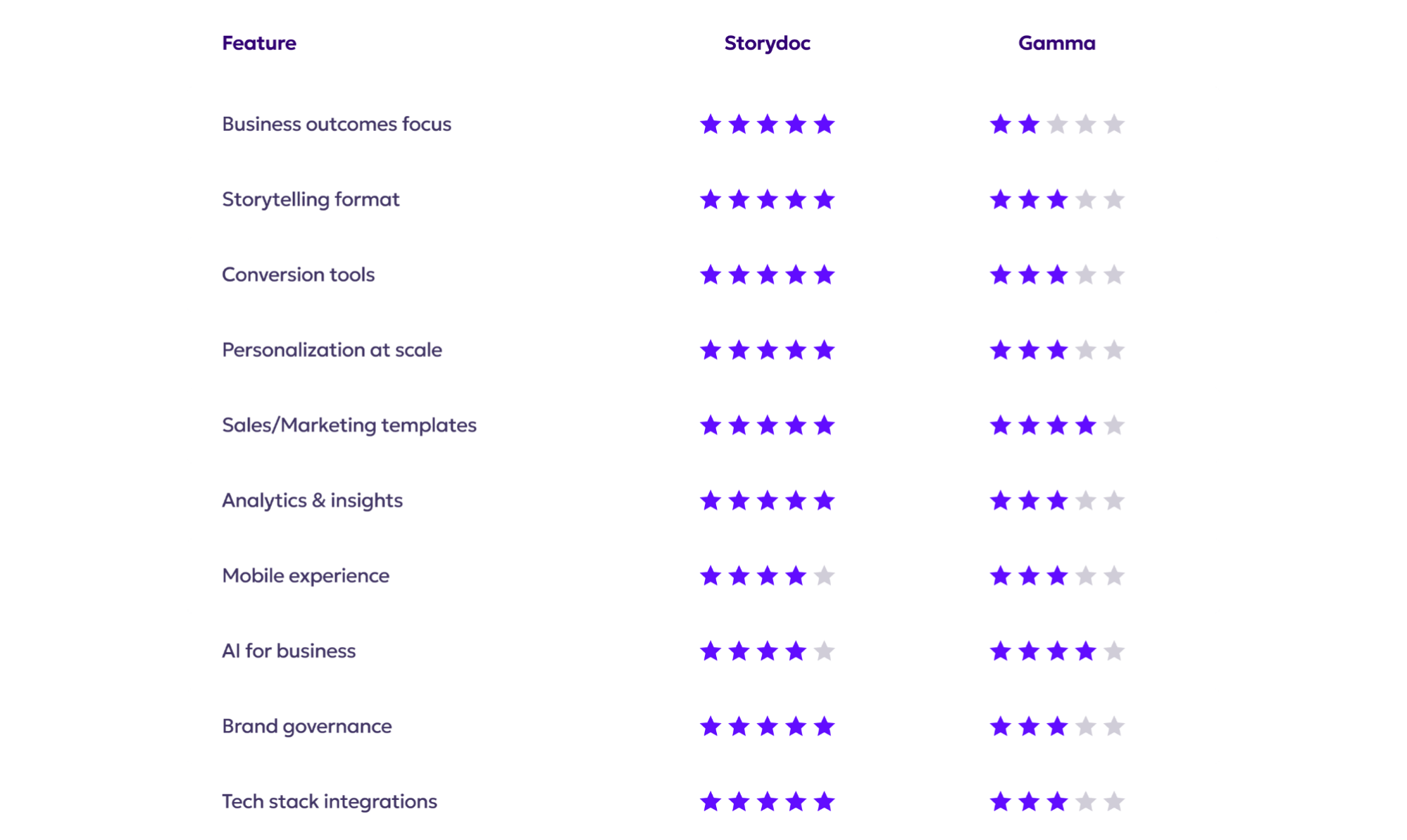
Quick comparison guide

Storydoc vs. Gamma
Storydoc vs. Gamma

Built for business outcomes

Storydoc vs. Gamma

Built around moving deals forward: interactive, conversion-ready docs designed for sales and marketing outcomes

Templates are structured around buyer journeys and proven to improve conversion metrics

Automated creation from CRM + bulk generation means the tool scales in real revenue workflows, not just one-off decks

Storydoc vs. Gamma

Excellent at fast creation of presentations and simple web docs with strong default design quality

Business outcome depends on how you operationalize it - Gamma produces the asset, but it’s not inherently a sales workflow engine

Great for fast content creation, but you still have to connect it to your sales process yourself

Storydoc vs. Gamma
Storydoc vs. Gamma
Storydoc vs. Gamma

Scroll-based storytelling

Storydoc vs. Gamma

Built for buyer-friendly, scroll-led sales stories that stay readable and structured as content gets longer

A seamless flow that increases reading time by 41% and engagement by 21%

Designed specifically for async selling, where the content guides the buyer when no rep is in the room

Storydoc vs. Gamma

Web-based and scrollable, but content still loads in sections, which can interrupt the sense of a smooth, continuous story

Presentation mode helps with live delivery, but the async story still relies on how you structure cards

Great readability, but less “sales-guided” by default - more general-purpose narrative than conversion-optimized storytelling

Storydoc vs. Gamma
Storydoc vs. Gamma
Storydoc vs. Gamma

Conversion tools

Storydoc vs. Gamma

Built specifically for sales workflows, with native CTAs, calendars, and forms embedded directly into the content

Lets buyers sign agreements and complete payments inside the document, without being sent elsewhere

Proven to reduce drop-offs and increase closing times by 30%

Storydoc vs. Gamma

Supports buttons and links, and allows embedding tools like Calendly or Google Forms

Does not include native payment modules or e-signature functionality within the document

Suitable for simple next steps, but not built for complete sales conversion flows

Storydoc vs. Gamma
Storydoc vs. Gamma
Storydoc vs. Gamma

Personalization at scale

Storydoc vs. Gamma

Generates personalized decks directly from CRM triggers and live deal data, without reps manually rebuilding variants

Bulk creation is a first-class workflow, letting teams create and send many customized decks at once from their system of record

Engagement activity syncs back to the CRM record, connecting personalization and follow-up in a single loop

Storydoc vs. Gamma

Gamma’s API and Zapier actions allow content to be generated from templates programmatically

There are no native CRM integrations, so personalization at scale relies on external automation tools like Zapier

Strong potential for scale, but less out-of-the-box CRM-to-deck compared to sales-native platforms

Storydoc vs. Gamma
Storydoc vs. Gamma
Storydoc vs. Gamma

Tailored for sales & marketing

Storydoc vs. Gamma

Built specifically for sales and marketing teams, with templates optimized for pitch decks, product demos, proposals, and other core B2B documents

Uses content layouts designed around proven B2B storytelling patterns, with messaging that naturally highlights value, outcomes, and ROI

Fits directly into GTM workflows, with CRM-driven creation and engagement activity flowing back to the record

Storydoc vs. Gamma

Flexible enough for many use cases (presentations, docs, simple web pages), but that flexibility leaves sales teams without much guidance

Final structure and narrative are largely up to the user, which works well for designers but puts more burden on sellers trying to drive conversion

Relies heavily on AI and manual setup for structure, rather than providing sales-specific templates and messaging out of the box

Storydoc vs. Gamma
Storydoc vs. Gamma
Storydoc vs. Gamma

Performance tracking & insights

Storydoc vs. Gamma

Tracks deep engagement signals across the entire funnel, including what was viewed, interacted with, and where attention drops

Real-time alerts help reps follow up while intent is high

Analytics can flow into your CRM and wider stack, so insights automatically trigger next steps

Storydoc vs. Gamma

Gamma Analytics shows card views, time spent per card, and unique viewers, but lacks information on CTA button clicks

Useful as a feedback loop for improving content quality and templates, especially for teams producing lots of decks

Analytics stay inside Gamma, with no native way to export or sync engagement data into a CRM for sales follow-up

Storydoc vs. Gamma
Storydoc vs. Gamma
Storydoc vs. Gamma

Mobile performance

Storydoc vs. Gamma

Mobile-responsive by design, built for decision-makers who open links on phones between meetings

Interactive layouts keep content readable on any screen size and usable without pinch/zoom

Nails the experience for the 47% of outreach decks opened on mobile

Storydoc vs. Gamma

Web-first format generally holds up well on mobile compared to traditional slide tools

Card-based layouts tend to stay readable, though embed-heavy pages can still become “scroll-and-squint” depending on content

Good mobile experience overall, but it’s not explicitly built around mobile-first sales conversion paths

Storydoc vs. Gamma
Storydoc vs. Gamma
Storydoc vs. Gamma

AI-powered content creation

Storydoc vs. Gamma

StoryBrain lets you feed in real business context (documents, decks, websites, brand materials) and generates structured, on-brand content from it

You can start with a prompt and then refine individual slides or sections using the built-in assistant, without breaking your workflow

AI output is designed to land inside interactive, sales-ready layouts, producing content that’s instantly usable

Storydoc vs. Gamma

Can generate decks and pages from prompts and uploaded documents, making it very fast to create a first version

Excels at quickly producing well-structured, visually appealing content with minimal manual input

Uploaded content is used per document, rather than as a persistent source of context you can reuse across multiple assets

Storydoc vs. Gamma
Storydoc vs. Gamma
Storydoc vs. Gamma

Brand guardrails & governance

Storydoc vs. Gamma

Enterprise-grade governance and security (including ISO 27001) built for company-wide rollout

Lockable styles and layouts, shared workspaces and templates, and smart permissions help keep content consistent as companies scale

Sales teams can move fast without breaking brand rules

Storydoc vs. Gamma

Supports custom themes (colors, fonts, styles) that can be shared across a workspace

Includes basic workspace permissions and roles, allowing admins to manage access and sharing

Lacks publicly documented enterprise certifications (such as ISO 27001), making governance more flexible than controlled

Storydoc vs. Gamma
Storydoc vs. Gamma
Storydoc vs. Gamma

Integrated business ecosystem

Storydoc vs. Gamma

Native integrations with multiple sales and marketing tools, such as Salesforce, HubSpot, Gong, and more

Also connects to Zapier for broader automation, so Storydoc fits naturally into complex sales stacks

Built for bi-directional workflows: create → send → track → sync engagement back into the system of record

Storydoc vs. Gamma

Does not offer native CRM integrations

Can be connected to sales tools through Zapier or API workflows, but this requires manual setup

Integrations lean more toward content and creative tools than sales systems, which makes sales workflows less plug-and-play

Storydoc vs. Gamma
Storydoc vs. Gamma

So, what’s it going to be?

Do you want a content builder that looks great, but leaves you to optimize every deck for sales?

Or a solution built for selling - where every doc is interactive, personalized, and tracks what modern buyers care about?

Gamma is great for design.

Storydoc is like Gamma, but made for teams that need content to convert.

It’s time to go beyond aesthetics and focus on content that drives deals forward.

Storydoc vs. Gamma