Storydoc vs. Visme

Visme is strong at helping non-designers produce decent-looking visuals quickly - presentations, infographics, documents, social graphics, even whiteboard-style content.

But sales teams don’t need “a bit of everything.” As a salesperson, you need a system that drives pipeline: content that converts, plugs into the CRM, and scales across the funnel.

You need a platform built for sales outcomes end-to-end.

You need…

Storydoc.

Storydoc vs. Visme

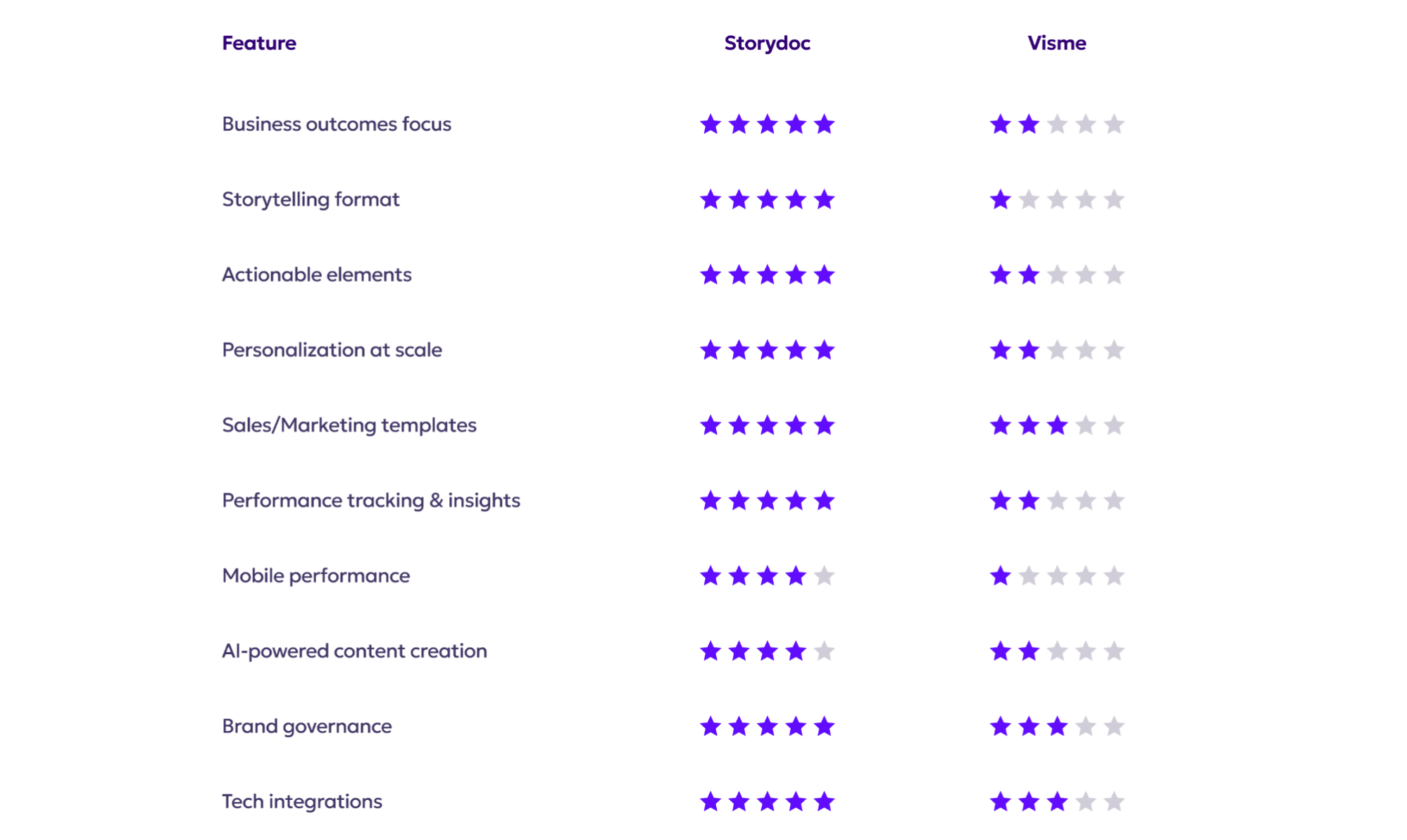
Quick comparison guide

Storydoc vs. Visme
Storydoc vs. Visme

Built for business outcomes

Storydoc vs. Visme

Storydoc is built to move deals forward with sales-ready, conversion-led formats

Templates are structured around real buyer journeys, with layouts and embedded CTAs designed to drive leads, conversions, and sales

Designed for repeatable revenue workflows, from lead generation through to signed contracts, with engagement signals feeding back into follow-up

Storydoc vs. Visme

Visme is strong for producing visual assets across many business needs, but not built around sales outcomes specifically

Even Visme’s own AI pitch is “AI PowerPoint” generation, which signals a presentation-first mindset rather than a funnel engine

Great for internal comms, social media, and infographics

Storydoc vs. Visme
Storydoc vs. Visme
Storydoc vs. Visme

Scroll-based storytelling

Storydoc vs. Visme

Built for scroll-led buyer journeys that mimic a modern web page and stay structured even as content gets longer

Designed for async selling, where the content guides the reader when no rep is present

Proven to increase the average reading time by 41% and engagement rate by 21%

Storydoc vs. Visme

Uses a click-through, slide-by-slide format rather than a continuous scroll experience

Breaking content into “next slide” interactions disrupts narrative flow and reduces engagement

Format is optimized for design projects, not independent, self-guided sales consumption

Storydoc vs. Visme
Storydoc vs. Visme
Storydoc vs. Visme

Actionable vs. passive

Storydoc vs. Visme

Built for conversion with native CTAs, calendars, and forms embedded directly into the flow

Lets buyers take next steps inside the doc (including signing and paying), without bouncing between tools

Optimized layouts based on 1.3M+ sessions of high-performing decks

Storydoc vs. Visme

Supports links, buttons, and basic interactive elements, but isn’t built around sales conversion mechanics and lacks native calendar scheduling

No native e-signature - Visme explicitly recommends exporting a PDF and using another signing tool

No payment modules - closing actions happen outside the content

Storydoc vs. Visme
Storydoc vs. Visme
Storydoc vs. Visme

Personalization at scale

Storydoc vs. Visme

You can create multiple personalized decks in seconds using CRM data and custom variables

Designed for high-volume use, where personalized decks can be generated from a single source and sent in bulk with no recipient limits

Personalized decks see up to 68% full reads and, depending on depth, drive up to 47% higher engagement

Storydoc vs. Visme

Supports personalization through dynamic fields, but it’s not sales-native

Dynamic fields are limited unless you’re on an Enterprise plan, which restricts how far you can scale customization

Not scalable for large outreach efforts

Storydoc vs. Visme
Storydoc vs. Visme
Storydoc vs. Visme

Tailored for sales & marketing

Storydoc vs. Visme

Templates and layouts are optimized for B2B sales formats (pitch decks, product demos, proposals, one-pagers, and more)

Built around persuasive structure - value, ROI, proof, next steps - not generic design categories

Supports consistent funnel messaging by reusing the same blocks across funnel stages

Storydoc vs. Visme

Designed for broad content creation (presentations, infographics, social media, docs), not sales-first workflows

Puts more responsibility on the rep to choose the right structure and build the story from scratch

Better suited to designers/marketers producing assets than sellers trying to drive conversion

Storydoc vs. Visme
Storydoc vs. Visme
Storydoc vs. Visme

Performance tracking & insights

Storydoc vs. Visme

Tracks detailed engagement metrics including opens, scroll depth, time spent per section, clicks on CTAs, and drop-off points

Sends real-time alerts, so sales reps can follow up while the intent is high

Engagement data can sync into your CRM and analytics stack, so views and actions trigger follow-ups, tasks, or workflows automatically

Storydoc vs. Visme

Provides per-project analytics such as total views, unique visitors, average time spent, completion rates, and visit duration

Advanced metrics (like time spent per slide) are only available on the Enterprise plan

Data is exported as CSV, which means insights require manual analysis or importing into other tools rather than syncing natively into your stack

Storydoc vs. Visme
Storydoc vs. Visme
Storydoc vs. Visme

Mobile performance

Storydoc vs. Visme

Built mobile-first for real buyer behavior, with 47% of outreach decks opened on mobile

Interactive layouts stay readable and usable without pinching and zooming

Keeps CTAs and next steps clear and easy to act on from smaller screens

Storydoc vs. Visme

Slide-by-slide formats are designed desktop-first, which translates less cleanly to phones

Not all elements are optimized for mobile, so viewers often need to pinch and zoom to read or interact

Built for print and social media, not mobile-first business deals

Storydoc vs. Visme
Storydoc vs. Visme
Storydoc vs. Visme

AI-powered content creation

Storydoc vs. Visme

Lets you feed in existing materials (decks, documents, websites, brand assets) and use them as a source of truth across all sales content

You can start from a prompt, then edit individual slides or sections with the built-in assistant without leaving your workflow

You can easily modify the AI’s knowledge to create hyper-personalized decks

Storydoc vs. Visme

AI is positioned as a way to generate a quick first draft of presentations (often described as “AI PowerPoint”)

Uploaded documents are used to generate a single project, not as a knowledge base reused across multiple decks

Visme’s AI focuses on layout and visual structure rather than guiding business storytelling or conversion

Storydoc vs. Visme
Storydoc vs. Visme
Storydoc vs. Visme

Brand guardrails & governance

Storydoc vs. Visme

Built for controlled scale, with enterprise-ready security standards (including ISO 27001) supporting org-wide adoption

Central workspaces, real-time collaboration, shared libraries, and role-based permissions keep teams on the same page without slowing them down

Makes it easy to maintain brand and compliance consistency while teams work independently

Storydoc vs. Visme

Offers solid brand management tools for design consistency, including brand kits, templates, and shared styles

Governance tools focus on keeping visuals consistent, rather than business-specific controls

Lacks enterprise-grade compliance standards (such as ISO 27001), making it less suited for tightly governed sales environments

Storydoc vs. Visme
Storydoc vs. Visme
Storydoc vs. Visme

Tech stack integrations

Storydoc vs. Visme

Connects directly to CRM systems, so decks can be created and updated using live deal data

Works with Zapier to automate follow-ups, handovers, and other sales workflows across your stack

Engagement data flows back into your tools, so content activity actually informs what happens next

Storydoc vs. Visme

Integrates with many tools (including CRMs), mainly to support content sharing and distribution

Visme's integrations support content-related use cases rather than sales-driven automation

Limited bulk creation of decks at scale

Storydoc vs. Visme
Storydoc vs. Visme

So, what’s it going to be?

Do you want a broad visual content tool that helps anyone create nice-looking assets?

Or do you want a sales content platform designed to drive outcomes?

Visme helps teams create.
Storydoc helps sales teams convert.


It’s time to go beyond sending nice decks and start closing with content that drives pipeline.

Storydoc vs. Visme