The State of Outreach Decks: One-Pagers & Brochures in 2026

We analyzed 1.3 million presentation sessions to uncover what works in outreach these days - from how people read one-pagers to what gets meetings booked.

Outreach deck statistics

helped business
professionals at:

WorkDay IHeart Meta Nice American Cancer Society Xerox

Outreach decks are some of the hardest-working content in any sales process.

One-pagers, brochures, and intro decks usually land in a prospect’s inbox cold - with no prior relationship or built-in trust.

They’re often opened on mobile between meetings and judged in seconds.

And unlike proposals or pitch decks, they don’t get the benefit of high intent. They’re there to spark interest, not close a deal.

That’s exactly why they deserve their own set of statistics.

When you isolate the data just for top-of-funnel decks, you start to see what really makes a difference - which elements earn attention and which ones are most likely to prompt follow-up.

Below are the key takeaways from how real prospects interact with one-pagers and brochures today, based on our analysis of over 1.3 million Storydoc sessions.

If you rely on cold decks to start warm conversations, this is a must-read.

1. Outreach decks have the lowest starting interest - and that’s normal

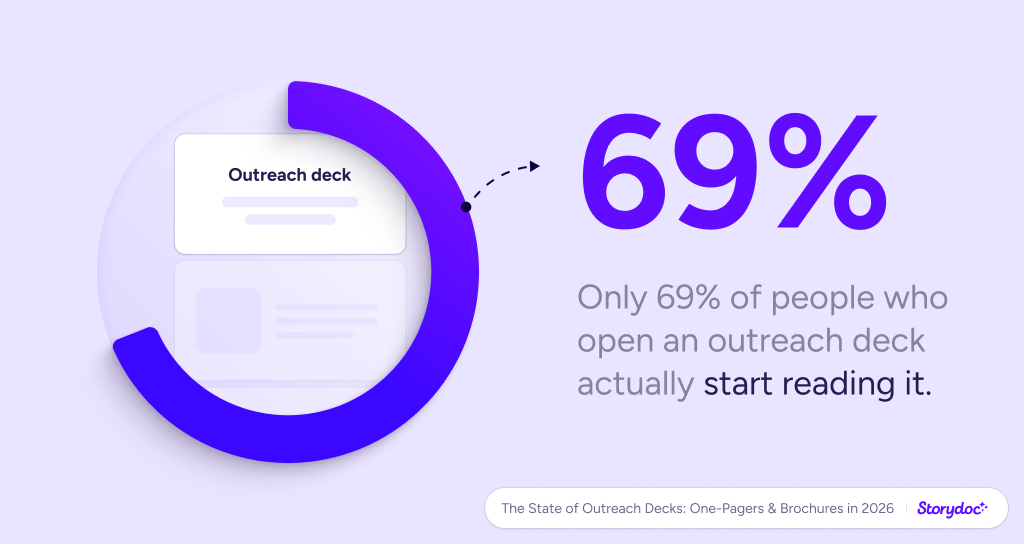
Only 69% of people who open a brochure or one-pager actually start reading it. That’s noticeably lower than:

  • 81% for pitch decks

  • 86% for customer success decks & general collateral

  • 92% for proposals

How likely is someone to start reading your deck?

But that drop-off doesn’t mean your content is bad. It means outreach decks are judged under completely different conditions.

These are decks that show up cold - often with no context and no prior relationship.

They’re opened quickly, skimmed even faster, and closed the moment something feels generic or irrelevant.

That’s why measuring them by the same standards as mid-funnel or late-funnel content misses the point.

The job of an outreach deck isn’t to walk someone through your full story. It’s to get them to care enough to keep going.

Storydoc outreach deck statistics

2. The first 10 seconds make or break your outreach deck

When someone opens a brochure or one-pager, you don’t have a lot of time to make an impression. You have ten seconds - at most.


The data shows:

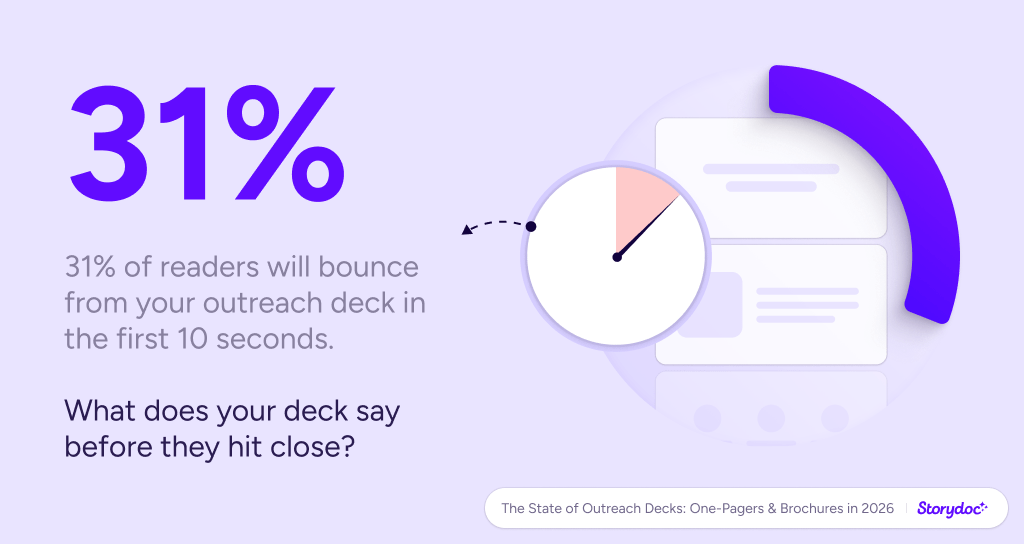
  • 31% of people bounce within the first 10 seconds

  • Another 15% are gone after the first minute

  • After that, drop-off slows down significantly

This early behavior tells you everything about how outreach content works.

The biggest drop doesn’t happen midway through your pitch. It happens before your pitch even begins.

That’s why what someone sees in the first few seconds matters more than anything else.

If you don’t hook the reader right away, they’re not sticking around to see what they missed.

Storydoc outreach deck statistics

3. Once they get past slide 3, most people will read your deck to the end

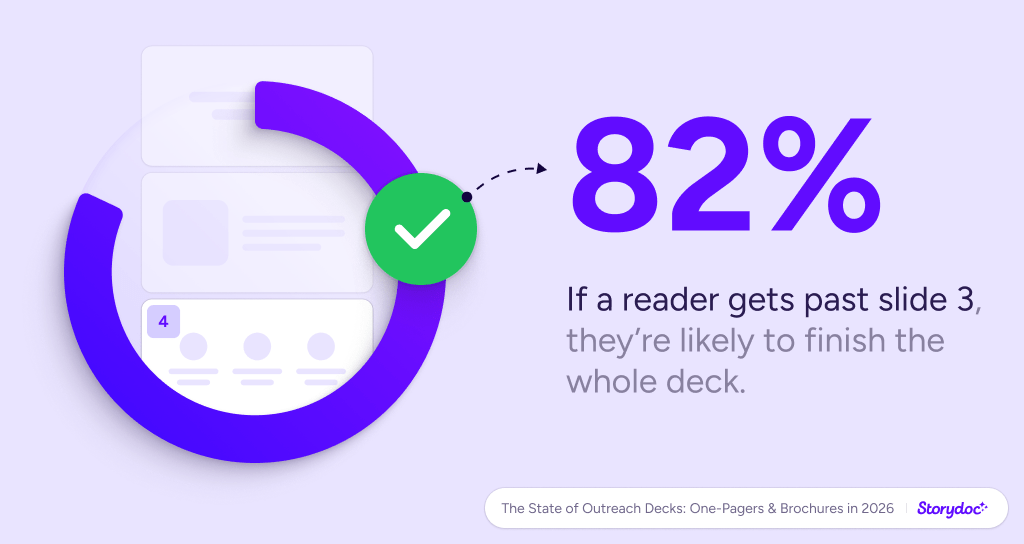
One stat holds true across every type of deck: 82% of people who make it through the first three slides go on to finish the entire thing.

That makes the opening sequence of your outreach deck the single most important part to get right - especially when you’re working with low intent and limited time.

82%

of people who reach slide 4 read the whole deck

And with outreach decks, there’s a catch.

They’re short by nature - often 5 slides or less - so you can’t afford to waste a single one.

There’s always the temptation to cram in everything, just in case the reader doesn’t click through. But that usually backfires.

You still need to be strategic.

The deck shouldn’t feel overloaded, but it also can’t be so lean that it leaves people unsure why they should care.


For brochures and one-pagers, a strong opening usually looks something like this:

  • Cover slide: Personalize the basics. Add the prospect’s name or company, include their logo if you can, and consider using a video background to give the deck a more dynamic first impression.

  • Slide 2: This is where a personal note works best. A short message that shows you’ve done your homework - and that this deck was made for them - helps move it out of “generic brochure” territory fast.

  • Slide 3: Follow it up with a strong hook. That might be a bold claim, a clear problem statement, a compelling stat, or a quick preview of the results you help clients achieve.


The rest of the deck only works if people actually make it that far - so those first few slides matter more than anything else.

They need to be easy to scan, visually engaging, and give the reader a reason to keep going.

Storydoc outreach deck statistics

4. Personalization is your biggest edge in outreach. Here’s how to get it right

The one thing no one expects in a one-pager or brochure is personalization. I mean, why would they?

A static one-pager is usually treated like a résumé - everything crammed into a single page, meant to be printed, not customized.

And when you think “brochure,” you picture a glossy tri-fold with generic language and stock photos.

These formats were never designed to feel personal - and people don’t expect them to.

That’s why interactive outreach decks have such an advantage.

They look familiar on the surface - but the moment someone sees their company name, logo, or a slide that reflects their needs, it breaks the pattern.


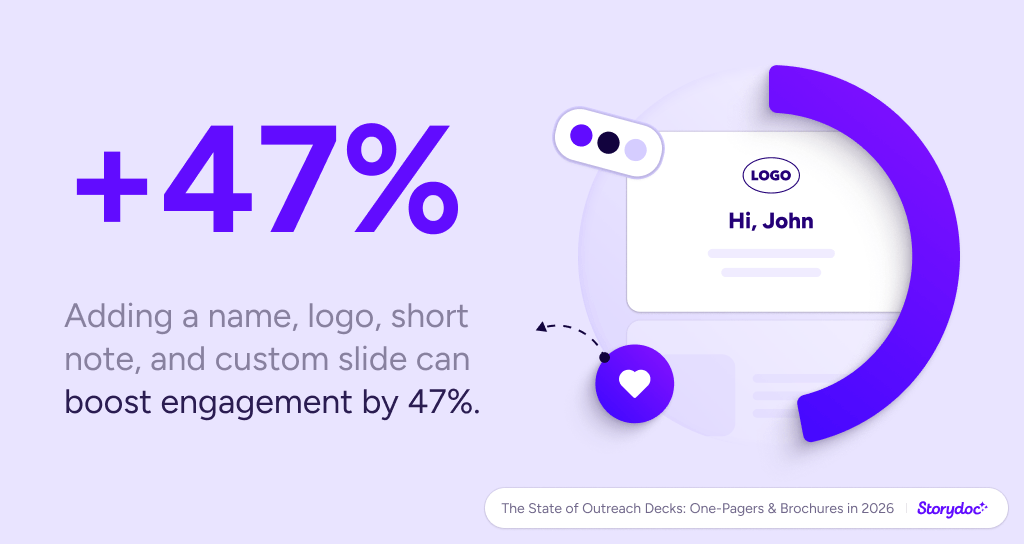
Here’s how different levels of personalization can boost engagement:

  • Just a company name and logo = +12%

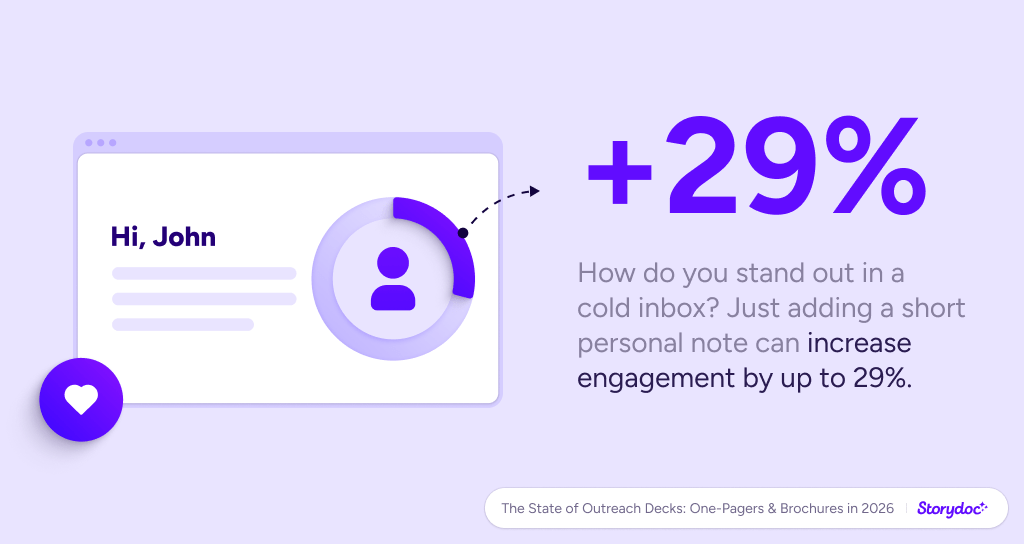
  • Add a first name and short message = +29%

  • Include one or two bespoke slides = +33%

  • Combine all of the above = +47% engagement


At the top of the funnel, where attention is fragile and trust is low, this kind of personal touch gives you a real advantage.

Benefits of different types of personalized decks:

Storydoc outreach deck statistics

5. Adding a personal note helps your deck break through the noise

One of the simplest ways to personalize an outreach deck is with a short message and a face.

It doesn’t have to be long or over-engineered - just something that tells the prospect you took the time to tailor it to them.


Here’s how different types of personal notes impacted engagement:

  • A short text-only personal note = +13% engagement

  • Add your photo = +24%

  • Include your prospect’s photo = +29%

Benefits of adding a personal note to your outreach deck:

That second slide - right after your cover - is the perfect place for it. Drop in a sentence or two, maybe your face, and let the reader know this deck was built with them in mind.

In a sea of mass outreach and lookalike brochures, it’s a small gesture that changes how the whole deck is received.

Storydoc outreach deck statistics

6. There’s one tailored slide that can boost engagement by 31%

There’s one slide that consistently performs well in outreach - and it’s one most people never think to include.

Later down the funnel, it’s common to quote what the prospect told you on a call to make your deck feel more personal. But in outreach, that kind of context doesn’t exist yet.

You haven’t had a conversation, so a lot of people assume there’s nothing meaningful to say - and leave it out entirely.

That’s exactly why adding this kind of slide gives you an edge.

Even at the top of the funnel, you can still speak to common pain points based on their role, industry, or growth stage. And when you do that well, it shows you understand the world they’re operating in - because you’ve seen it before.

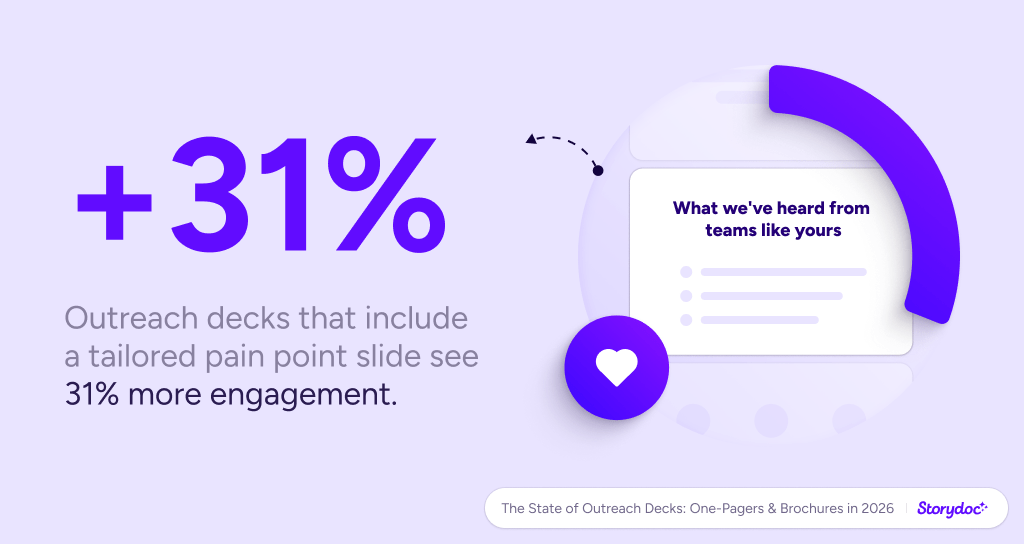
The most effective outreach decks include a short slide near the start with a headline like “What we typically hear from teams like yours.”

Benefit of adding a "What we've heard from teams like yours" slide:

+31%

Higher engagement on your deck

All you need is a few bullet points that sound familiar to your reader - because it mirrors challenges you regularly see when working with teams like theirs.

That small touch lifts engagement by 31%.

And it does something else, too - it shifts the focus away from your product and toward their challenges. That’s what builds trust early, and what makes people want to keep reading.

Storydoc outreach deck statistics

7. Shorter outreach decks get finished more often

Outreach decks are often treated like a one-shot pitch - everything packed into a single document, just in case the reader doesn’t click again.

But the data shows this approach usually backfires.

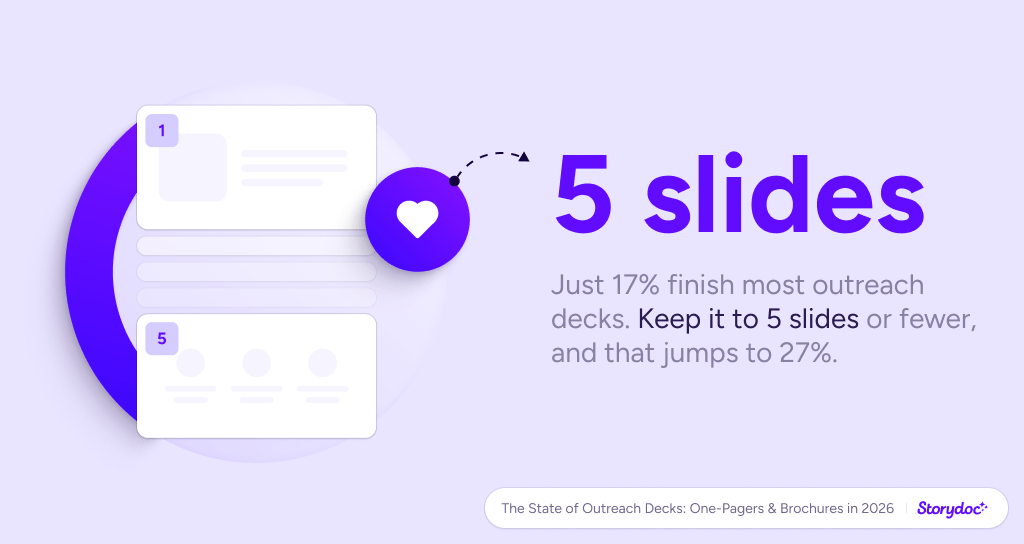
On average, only 17% of people who open a one-pager or brochure end up reading the whole thing. But when the deck has fewer than 5 slides, that number jumps to 27%.

In other words: Cutting content can increase your chances of getting seen.

That doesn’t mean you have to leave important information out - just that you need to structure it differently. And interactive decks give you options static formats don’t.

You can embed a short video instead of writing a wall of text. Segment your messaging into tabs so the reader only sees one thing at a time.

Use “read more” buttons to keep things clean. Or link out to another doc entirely when something needs more depth.

The goal is to say just enough to keep people moving and make them want to hear the rest.

Storydoc outreach deck statistics

8. Nearly half of all outreach decks are opened on mobile

The higher up the funnel you go, the more likely your deck is being read on a phone.

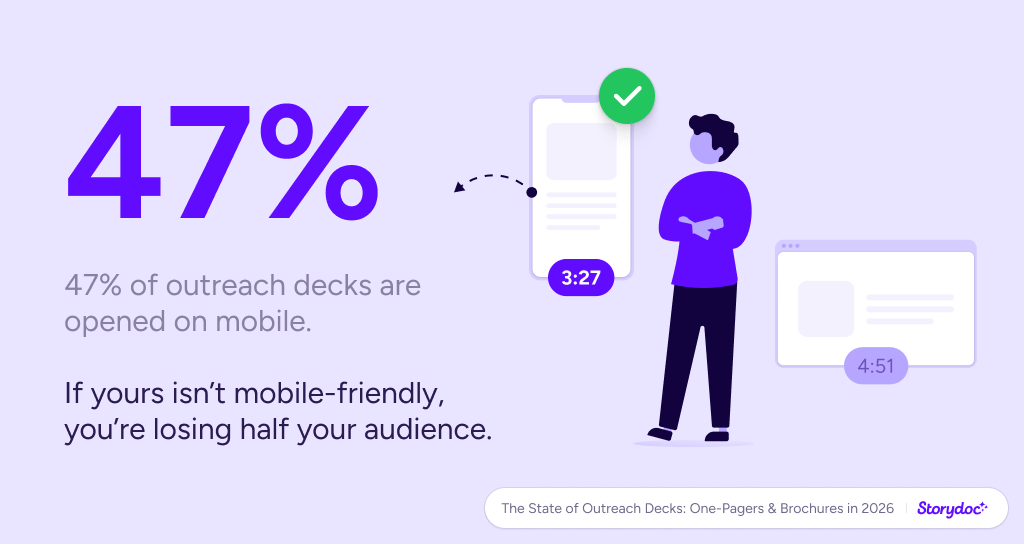
In fact, 47% of outreach decks are opened on mobile, compared to just 19% of business proposals.

That means there’s a good chance your one-pager or brochure is being skimmed on a small screen, in between meetings, or while someone’s walking to their next call.


Here’s the average reading time by device:

  • 4:51 on desktop

  • 3:27 on mobile

Avg. reading time by device:

So while mobile readers may move a little faster, they’re still actively evaluating. But they won’t be patient.

If your deck forces them to zoom in, pinch around, or scroll past awkward layouts, they’ll close it and move on.

Interactive formats solve for this by default - they adapt to different screen sizes, keeping your content readable, structured, and easy to engage with, no matter how or where it’s opened.

If your outreach deck isn’t mobile-responsive, you’re losing nearly half your audience before they’ve even seen your pitch.

Storydoc outreach deck statistics

9. Adding a calendar link boosts meeting bookings by 27%

Outreach decks rarely lead to a sale on their own - but a booked meeting? That’s within reach.

And one of the simplest ways to increase the chances of that happening is to include a personal calendar link right inside the deck.


Our data shows:

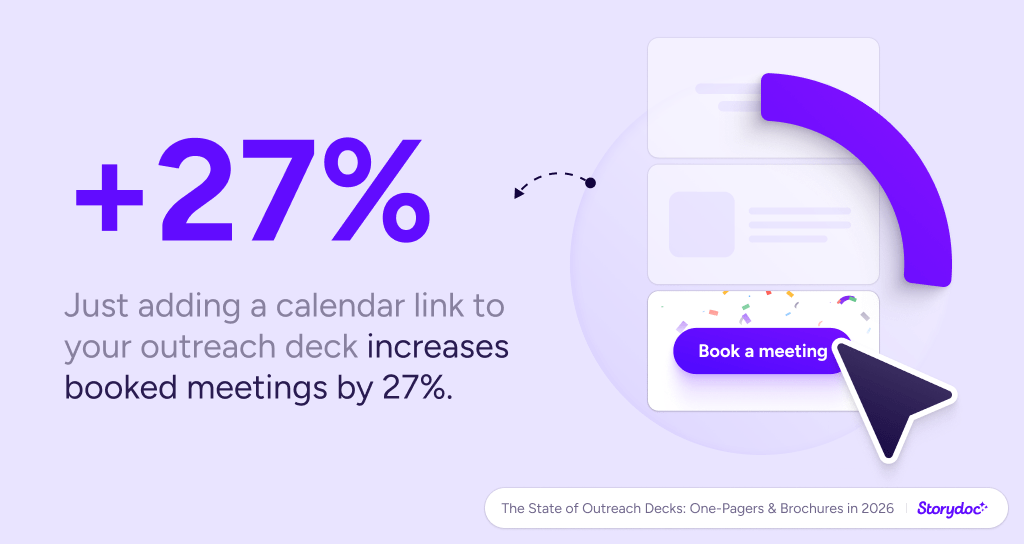
  • +27% increase in booked meetings when a calendar link is included in brochures or one-pagers

  • That’s more than double the impact it has at the proposal stage (+11%)

Impact of embedding a calendar in your deck:

This makes sense. At the top of the funnel, prospects aren’t looking to sign a deal - they’re just deciding whether it’s worth having a conversation.

If they’re interested, they’ll want a simple next step. They won’t go digging through emails or playing calendar ping-pong. Especially on mobile, they’ll expect it to be quick and frictionless.

That’s why a personal calendar link works so well. It turns a passing interest into a scheduled meeting - with one tap.

Storydoc outreach deck statistics

10. Most meetings are booked within a week - or not at all

When an outreach deck works, it usually works fast.


According to our data:

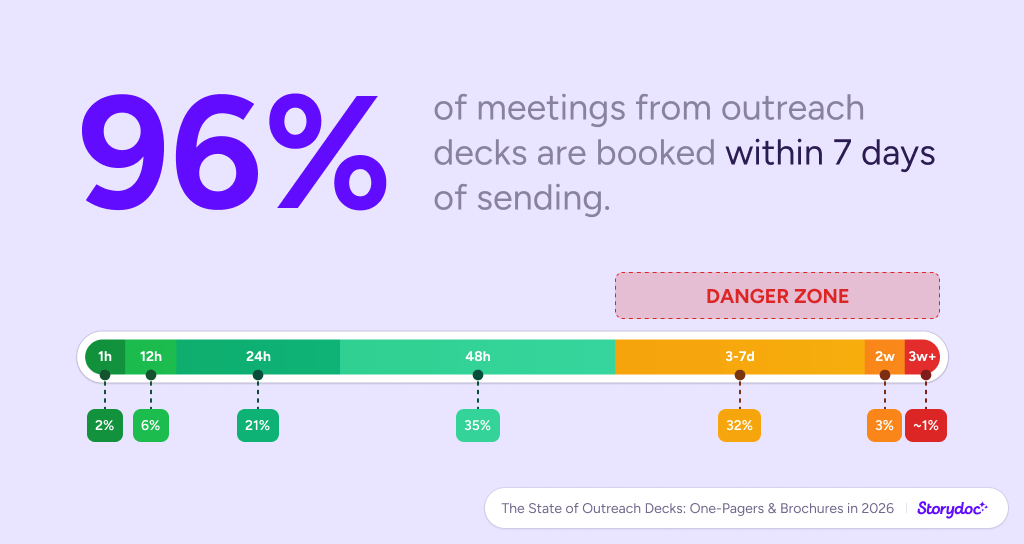
  • Only 2% of meetings are booked within the first hour

  • That jumps to 6% by 12 hours, and 21% by the 24-hour mark

  • 35% are booked within 48 hours

  • Another 32% come in between days 3-7


This means that 96% of meetings are booked within the first week.


After that, the odds drop off sharply:

  • Just 3% are booked during the second week

  • After two weeks, the chance of booking falls below 1%


So, if you’re still waiting for a reply a week later, the issue probably isn’t your follow-up - it’s the deck itself.

When do meetings from outreach get booked?

Outreach content has a short shelf life. If the reader opens it and doesn’t feel it’s relevant or worth acting on, they’re not coming back to give it a second chance.

A strong first impression, a clear hook, and an easy next step all matter more than clever nudges later. Because by the time the follow-up email lands, your prospect may have already moved on.

Storydoc outreach deck statistics

And that’s it from us for now!

Want to share our findings? Go for it! All images, animations, and data points featured in this study are available for reuse. Just make sure to reference the source and link back to this page to give proper credit.

If you’d like to put these insights into practice, we’ve created a gallery of professionally designed outreach templates - including brochures, one-pagers, and intro decks - all built around the findings from this research.

Every layout, interaction, and structure was designed to match how real prospects actually engage with top-of-funnel content.


You can check out the full gallery here:

No templates found

If you’re looking for more guidance, we’ve also curated some of our most in-depth resources on creating effective outreach materials:


And of course, stay tuned - there’s more fresh data coming soon!

Methodology and limitations

This study is based on the behavior of readers across more than 1.3 million presentation sessions, including brochures, one-pagers, and intro decks created and shared using Storydoc.

We only included live documents - decks that were actually sent to prospects - so all findings reflect how real people interacted with real outreach materials.

Unless otherwise noted, every comparison is based on decks that included a given element versus those that didn’t. For example, decks that featured a personal calendar link were directly compared to those without one.

To ensure accuracy in engagement metrics, we excluded upper outliers - such as decks left open for several hours - to prevent skewed averages.

The decks in this study came from companies of all sizes, across a wide range of industries. Given the scale and diversity of the sample, the findings are broadly representative of how outreach decks perform across different sectors and use cases.

Itai Amoza

Hi, I'm Itai, one of Storydoc's co-founders. As a data geek, I couldn't hold myself from jumping into our data and discovering what makes top-performing sales decks so successful. I'm excited by the opportunity to share our findings and contribute to the sales and marketing community!

Engaging decks. Made easy

Create your best outreach deck to date.

Stop losing opportunities to ineffective presentations.
Your new amazing deck is one click away!