

Brand Governance: What It Is and How to Enforce It in 2026
Learn what brand governance is, why it matters, and how to keep your brand consistent with the right rules, workflows, and AI controls.
Set as Preferred Source
There was a time when going off-brand meant someone stretched your logo, picked the wrong shade of blue, or decided Arial was close enough to your carefully chosen company font.
Annoying? Sure. Catastrophic? Probably not.
These days, the stakes are a little higher.
A salesperson can now ask an AI tool to generate a proposal and, within minutes, end up with completely new messaging, an outdated product description, an invented price, stock imagery you would never approve, and a visual style bearing only a passing resemblance to your actual brand.
And there may be dozens or hundreds of people doing the same thing across sales, marketing, customer success, agencies, regions, and partner teams.
That’s why brand governance can no longer stop at publishing brand guidelines and hoping everyone follows them.
By the end of this guide, you’ll understand what brand governance looks like in 2026, why it matters, and how to put the right rules, tools, and processes in place without slowing your team down.
What is the difference between brand guidelines and brand governance?
Brand guidelines tell people what your brand should look and sound like.
Brand governance determines how those standards make their way into the work people actually produce.
| Brand guidelines | Brand governance |
|---|---|
| Define how the brand should look and communicate | Determines how brand standards are applied and enforced |
| Cover elements such as colors, fonts, logos, imagery, voice, and terminology | Covers roles, permissions, templates, workflows, approvals, systems, and controls |
| Tell people what is correct | Make correct usage easier or mandatory |
| Act primarily as a reference | Acts as an operating system for the brand |
You may also hear brand management mentioned alongside brand governance, but they’re not quite the same thing.
Brand management is the bigger picture: how you build, position, and develop your brand over time.
Brand governance is about making sure the rest of the organization actually follows the standards you’ve put in place.
Why is brand governance important?
Brand governance matters because your customers don’t experience your brand guidelines.
They experience the email a salesperson sends them. The proposal they open before a buying meeting. The product page they find on Google. The deck your partner presents at an event. The onboarding material they receive after signing.
If each one looks, sounds, or behaves like it came from a different company, the fact that somebody at HQ has a beautiful 87-page brand book isn’t going to help much.
Good brand governance solves several practical problems at once.
It protects brand consistency and recognition
The most obvious benefit is consistency.
When your visual identity, terminology, messaging, and tone stay recognizable across different teams and channels, customers get a much clearer sense of who you are.
But maintaining that consistency gets harder as your company grows.
More employees start creating content, regional teams adapt materials for their markets, agencies get involved, and salespeople personalize presentations for individual accounts.
At that point, having the brand team personally review every customer-facing asset simply isn’t realistic.
Brand governance gives everyone clear rules and guardrails to work within, so you can keep the brand consistent without someone checking every logo, font, and slide before it goes out.
It keeps your messaging and information accurate
AI has made this part of brand governance much more important.
Imagine two proposals.
Proposal A uses the wrong blue.
Proposal B uses the right blue but includes a product you don’t sell, a feature that hasn’t launched, and pricing the AI politely invented because nobody gave it the real numbers.
Which one would you rather explain to the prospect?
Exactly.
Brand governance needs to protect what your company says as carefully as how it presents itself.
If people are using AI to create customer-facing content, that means giving those tools reliable product information, approved messaging, current pricing, and other trusted company knowledge to work with.
Otherwise, AI can confidently fill in the gaps itself.
For sales and marketing teams, that means product information, commercial terms, positioning, customer data, and approved claims now need to be part of your brand governance system too.
It helps you move fast without losing control
Without the right controls in place, companies often end up at one of two extremes.
Either everybody can create whatever they like and the brand slowly turns into a group project gone wrong.
Or the brand team has to approve absolutely everything, which means a salesperson changing a customer’s logo in a presentation may somehow require a three-day Slack thread.
As the amount of content your team creates grows, neither approach is practical.
Giving everyone complete freedom leads to more mistakes and inconsistencies, while reviewing every small change slows people down and creates unnecessary work for the brand team.
Good governance separates decisions that genuinely require expert judgment from routine changes that can safely happen within predefined limits.
For example, a sales rep might be free to personalize a proposal with a customer’s name, logo, challenges, and CRM data while being unable to alter the underlying brand system, product positioning, or master template.
That gives people the freedom to create and personalize content themselves, without giving them control over the parts of your brand that shouldn’t change.
It reduces rework and outdated content
Most brand inconsistencies don’t come from somebody deliberately ignoring the rules. They’re the result of small shortcuts, outdated information, or simply not knowing where to find the right resources.
Someone can’t find the current presentation, so they duplicate an old one.
A salesperson needs an image quickly and grabs one from Google.
The pricing changed last month, but not everyone got the memo.
Or creating a new layout themselves simply feels easier than going through the process of requesting one.
There, I said it: most employees are not waking up determined to sabotage your brand.
They’re simply trying to get their job done.
Effective governance recognizes that.
It makes approved templates, assets, information, and workflows easier to find and use than unofficial alternatives.
The fewer reasons people have to work around your brand system, the more likely they are to actually follow it.
It becomes essential when AI scales content production
AI has made it ridiculously easy to create more content.
And teams are taking advantage of it. According to Salesforce’s 2026 State of Marketing research, 75% of marketers now use AI, while 78% say they need more personalized content than they can currently produce.
Over in sales, AI adoption is even higher. Salesforce’s 2026 State of Sales report found that 87% of sales organizations already use AI, and 54% have used AI agents.
So, we’re no longer talking about the occasional employee asking ChatGPT to help rewrite an email. AI is becoming part of how companies create content every day.
The problem is that these tools don’t automatically know your latest pricing, approved messaging, product offering, brand rules, or what they’re allowed to change.
And producing something quickly doesn’t necessarily mean producing something you can actually send to a customer.
That’s showing up in the research too. In a Gartner survey of 418 marketers, 77% said they were exploring generative AI, but only 44% reported seeing significant benefits. Gartner also found that producing on-brand content that’s ready to publish at scale remains a challenge.
So, the question is changing from:
Can our team create enough content?
to:
Can our team create more content without losing control over what gets published?
And that is a brand governance problem.
It keeps your brand consistent, no matter where people start
One salesperson likes Claude. Another practically lives in ChatGPT. Someone has built a workflow in Copilot, marketing has its own tools, and by next quarter there’ll probably be another AI tool everyone suddenly wants to try.
Trying to keep your brand consistent by forcing everyone to start from the same place isn’t always realistic.
Good brand governance means they shouldn’t have to.
No matter which tool or workflow someone starts with, they should be working from the same approved templates, brand settings, company knowledge, permissions, and trusted data.
That way, your tech stack can change without having to rebuild your brand rules every time it does.
What should a modern brand governance framework include?
There’s no single brand governance framework that will work for every company.
A regulated financial institution will naturally need stricter controls and approval processes than a 20-person SaaS startup.
Even so, there are a few core elements that any effective brand governance framework should cover.
1. Clear brand rules and standards
Start with the familiar part.
Document the standards that should remain consistent, including:
-
Logo use
-
Brand colors
-
Typography
-
Imagery and video
-
Layout principles
-
Tone of voice
-
Preferred terminology
-
Product positioning
-
Approved claims
-
Naming conventions
-
Accessibility requirements
-
Legal or regulatory requirements
The important part is making those rules usable in practice.
“Sound friendly but professional” leaves a lot of room for interpretation.
A handful of representative writing examples, preferred phrases, terminology to avoid, and before-and-after examples give people – and AI – something much more concrete to work with.
2. Trusted sources of brand information
Traditionally, a brand’s source of truth might have been a digital asset management (DAM) system or brand portal where everyone could find the latest logos, images, icons, and templates.
With AI now creating customer-facing content too, your source of truth also needs to cover what your company knows.
After all, an AI tool can’t use your latest pricing, product information, or approved messaging if it doesn’t have access to it.
Depending on what you’re creating, that could include:
-
Current product information and positioning
-
Pricing and commercial terms
-
Approved claims, case studies, and research
-
Legal disclaimers and product documentation
-
Previous approved materials
-
Customer data and sales discovery notes
If your pricing lives in one system, customer information in another, and product updates somewhere else entirely, it’s much harder for AI to produce something accurate and useful.
Salesforce’s 2026 State of Marketing research found that disconnected systems and poor-quality data are still getting in the way of AI-powered personalization. Teams that have managed to bring their data together are 60% more likely to use AI agents to scale their work.
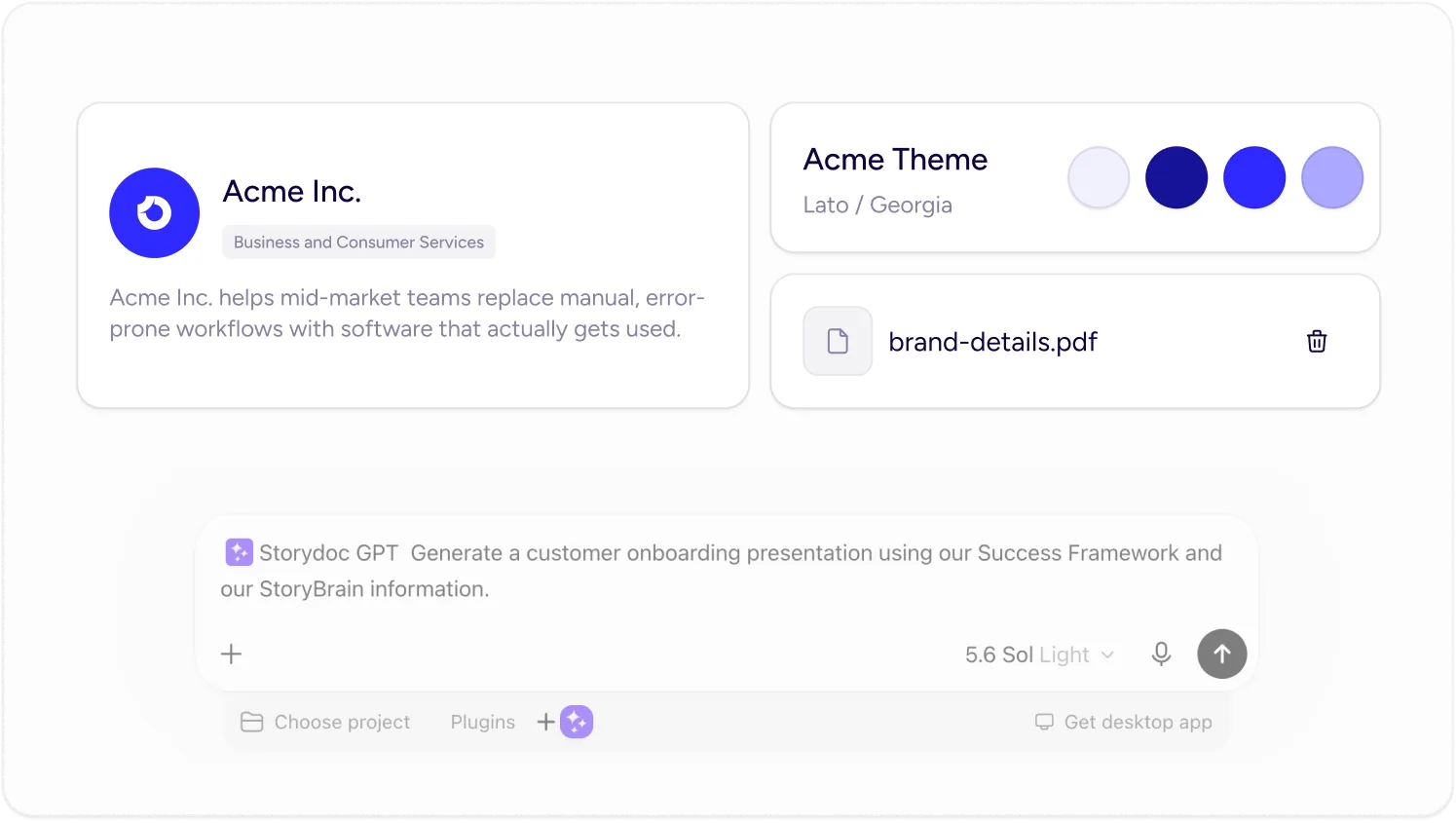
Storydoc takes a similar approach with StoryBrain, its built-in knowledge base for AI content creation. Teams can give StoryBrain access to company and client information from reports, proposals, contracts, websites, and other existing materials.
When someone uses AI to create a Storydoc, that information provides relevant business context for the content it generates rather than leaving the AI to rely on generic knowledge alone.
The principle is simple: don’t expect AI to know your business. Give it reliable access to the information your business already has.
3. Controlled templates and content structures
If your team creates the same types of content again and again, turn them into templates with your brand rules already built in.
That means deciding upfront which parts should stay consistent and which people should be able to customize.
For example, a template can define:
-
Required and optional sections
-
Approved content blocks and layouts
-
Brand styling
-
Information that must always appear
-
Variables that can be personalized
-
Data sources used to populate specific fields
This means every person creating a proposal doesn’t have to remember which sections to include, which layout to use, or what they’re allowed to personalize.
Those decisions have already been made in the template, leaving them to focus on the parts that actually need their input.
4. Role-based permissions
Not everyone needs the same editing rights.
Think about what different people actually need to do with your content.
A marketer responsible for the master sales presentation might need to change layouts, messaging, and brand settings.
A salesperson using that presentation for an upcoming meeting might only need to personalize it with the prospect’s logo, challenges, and other relevant details.
Your permissions should reflect those differences.
That’s how it works in Storydoc.
The people responsible for creating and maintaining your core content can be given permission to edit the underlying story and its design, while others can create personalized versions without changing the original.
There are different permission levels in between too, so you don’t have to choose between giving someone full editing access and locking everything down.
The goal is to give people enough control to do their jobs without letting every user change the parts of your content that are supposed to stay consistent.
5. Risk-based approval workflows
Requiring approval for every change might sound like the safest option, but it quickly becomes impractical when your team is producing hundreds of pieces of content.
Instead, decide what needs approval based on the risk involved.
A salesperson swapping in a prospect’s logo or using an image that’s already been approved shouldn’t need another round of review.
Changing pricing, introducing new imagery, making a performance claim, or editing legal language is a different story.
The idea isn’t to remove human approval. It’s to use it where someone’s judgment is actually needed, while allowing routine changes to happen within limits you’ve already agreed on.
If you want to go deeper into what should be checked, locked, or approved in customer-facing content, we’ve put together a practical sales and marketing compliance checklist covering sales decks, proposals, case studies, and brochures.
6. Set rules for what AI can use and change
Traditionally, brand governance has focused heavily on reviewing the finished result.
AI gives you another opportunity: control what it can use and change before the content is created.
For example, you can decide which templates AI can work from, which company knowledge and customer data it can access, which images it can use, and which parts of a document it’s allowed to personalize.
You can also set limits around higher-risk actions, such as changing pricing or publishing content without human approval.
This becomes especially important with agentic workflows, where AI can do more than generate a piece of copy. An agent might pull customer data from your CRM, create a personalized proposal, choose relevant content, and send it – all within the same workflow.
Agentic AI governance means putting appropriate controls around those actions, including what data an agent can access, what it’s allowed to change, and when it needs human approval.
The more AI can do on its own, the more important those controls become.
7. Regular reviews and updates
Brand governance isn’t something you set up once and forget about.
Products and pricing change, messaging becomes outdated, teams find new ways of working, and new AI tools make their way into the tech stack.
Set aside time to review whether your governance system still reflects how the business actually operates.
That might mean removing old templates and assets, updating product information, checking that permissions still match people’s roles, or looking at recurring AI errors and approval issues.
Pay particular attention to the workarounds people have created. If employees keep duplicating an old presentation, using an unofficial template, or finding another way around the approved process, simply telling them to stop probably won’t fix much.
Find out why they’re doing it. Maybe the right template is difficult to find, the approval process takes too long, or the official workflow doesn’t support something they regularly need to do.
Those workarounds can tell you exactly where your governance system needs to improve.
How to enforce brand governance without slowing your team down
A brand governance framework only works if people can actually follow it without making their jobs unnecessarily difficult.
That means building your rules around how content gets created in practice, not how you assume it gets created.
So, how do you make that happen? Here are a few best practices to follow.
Audit how customer-facing content is really created
Before changing anything, find out how people across the company are actually creating customer-facing content.
Ask a salesperson where they get the deck they send after a discovery call, how customer success puts together a QBR, where marketing finds campaign visuals, or which presentation the founder duplicates before an investor meeting.
It’s also worth finding out which AI tools people are already using and what they’re using them for.
You may find that the official process looks nothing like the one people follow day to day.
The latest templates might live in a shared library while half the sales team is duplicating an old PowerPoint from someone’s personal folder.
People may be reusing Canva files, pulling slides from previous campaigns, or asking AI to create something because finding the approved version takes too long.
Those workarounds are useful information. They show you where the official process isn’t meeting people’s needs and where your governance is most likely to break down.
Separate what must stay fixed from what should stay flexible
Review each frequently used content type and ask four questions:
-
What must never change without approval?
-
What should users personalize regularly?
-
What can users create freely?
-
What requires expert review?
This gives you a much more practical governance model than simply telling everyone to follow the brand guidelines.
For a sales proposal, for example, the layout and product positioning may stay fixed while prospect-specific problems, logos, metrics, and recommended solutions change every time.
We’ve covered this in more detail in our sales and marketing compliance checklist, including what to customize, what to lock, and which changes should go through an approval process.
Put the rules where people create
If creating one presentation means jumping between a PDF brand guide, shared asset folder, CRM, pricing spreadsheet, and tone-of-voice document, you don’t really have a workflow. You have a scavenger hunt.
Where possible, build your brand rules and approved resources into the tools people already use to create content.
That way, they don’t have to remember the right font, hunt down the latest logo, or check three different places to make sure they’re using the current information.
Storydoc, for example, lets teams set their brand colors, fonts, logos, and other design elements once so they’re automatically available when people create new content.
The same idea applies when people prefer to start somewhere else. A salesperson can ask Claude to create or personalize a Storydoc, for example, while Storydoc still provides the approved templates, company knowledge, and brand settings behind it.
The less people have to go looking for the rules, the easier those rules are to follow.
Automate personalization within clear limits
Personalization doesn’t have to mean giving people free rein to change everything.
Instead, decide upfront which parts are meant to vary and which should stay fixed.
Where that information already exists in your CRM or another business system, pull it directly from there rather than relying on someone – or an AI tool – to enter it manually.
After all, there’s very little benefit in asking AI to guess a customer’s annual contract value when your CRM already knows the answer.
Reserve human approval for decisions that need judgment
Human approval is valuable when there’s a genuine decision to make. If every tiny change needs someone to review it, though, you’re mostly creating a very busy inbox.
Save manual approval for higher-risk changes, such as introducing new brand messaging, making sensitive or regulated claims, changing pricing or contractual terms, or significantly altering an approved structure.
Routine personalization and variations that have already been approved should be able to move forward without another round of review.
This keeps people involved where their judgment actually adds value, without making them a required stop for every small change.
Train people on the workflow, not just the brand
Employees need to understand your brand, but “here’s our font, here’s our tone of voice, good luck” isn’t much of a training program.
Show people how to apply those rules in their day-to-day work.
They should know where to find approved information and templates, what they’re free to change, when they need approval, and who to ask when they’re unsure.
If AI is part of the process, training should cover that too.
Be clear about which tools people can use, what company or customer data those tools can access, and which information should always come from an approved source rather than whatever answer AI comes up with.
Knowing what your brand should look and sound like is only half the job. People also need to know how to create content that follows those standards in practice.
Brand governance example: A sales proposal workflow
Let’s make all of this a little less theoretical.
Imagine a sales rep has just finished discovery with a promising account and needs to send a proposal.
Without effective brand governance
The rep opens their favorite AI tool and types:
Create a sales proposal for Acme Corp based on our website.
The AI works with whatever information it can find, creates its own presentation structure, and summarizes your product in language that’s slightly different from what the sales team normally uses.
It picks a visual style, includes a feature mentioned on an old webpage, and fills a gap in the pricing section with something that looks plausible enough to be true.
The rep corrects the obvious mistakes but doesn’t notice the subtle ones, then exports the deck and sends it.
The whole thing took 15 minutes. Fast!
Unfortunately, a bunch of mistakes are now sitting in the prospect’s inbox wearing your logo.
With brand governance built into the workflow
Now imagine the same rep starts with an approved proposal structure where the company’s visual identity, core slides, and messaging are already in place.
When AI helps create the proposal, it can draw product information from trusted company knowledge and pull customer context from the CRM or discovery materials rather than filling in the gaps itself.
The rep can personalize the sections that are meant to change for each buyer while the master presentation, brand settings, and other protected content stay untouched.
Commercial information can come directly from the appropriate business source, and anything that falls into a higher-risk category can be sent for review before it reaches the prospect.
The rep still gets the speed and personalization they wanted in the first place, only with far less room for something unexpected to slip through.
In Storydoc, this can all happen within the same setup. Teams can combine approved templates and brand settings with StoryBrain knowledge, customer data, dynamic variables, and role-based permissions that determine what different users can edit.
And because a Storydoc is shared as a live link rather than an exported deck, governance doesn’t end the moment someone hits send.
If you spot a minor mistake or need to update something later, you can fix the original Storydoc without exporting a new version and asking the prospect to please ignore the attachment you sent five minutes ago.
That’s what effective brand governance looks like in practice: people don’t have to remember every rule because the rules are already built into the way they create and share content.
Brand governance best practices for 2026
If you’re reviewing your own brand governance model, keep these principles in mind:
-
Don’t expect guidelines to enforce themselves. Document your brand rules, then build them into the tools, templates, and workflows people actually use.
-
Protect your messaging and information as carefully as your visual identity. The wrong price or an inaccurate product claim can cause a lot more trouble than the wrong font.
-
Make the approved way the easiest way. If finding an old deck and editing it is quicker than using your official process, people will eventually do exactly that.
-
Be clear about what can and can’t change. Protect the parts that need to stay consistent while giving people room to personalize the content that should vary.
-
Give people the access they actually need. Someone who personalizes presentations for prospects doesn’t necessarily need permission to edit the master version.
-
Give AI reliable information to work with. Connect it to approved company knowledge and trusted business data rather than expecting it to know the details of your business.
-
Save approvals for changes that need human judgment. Routine, pre-approved changes shouldn’t have to go through the same review process as a new claim, pricing change, or piece of regulated content.
-
Set limits on what AI is allowed to do. This is an important part of agentic governance as AI takes on more of the workflow. Be clear about which data it can access, what it can change, and when a person needs to step in.
-
Pay attention to unofficial workflows. The presentation sitting on someone’s desktop might tell you more about where your governance is failing than the beautifully organized brand portal nobody uses.
-
Keep your governance up to date. As your company changes, your rules, information, assets, templates, permissions, and AI context need to change with it.
Brand governance FAQ
Brand management is the broader process of building, positioning, and evolving a brand, while brand governance is the system used to apply and enforce that brand consistently.
Brand management decides what the brand should become. Brand governance determines how employees, partners, systems, and tools represent that brand in practice.
Brand or marketing teams usually own the central standards, but effective brand governance involves people across the organization.
Sales, customer success, legal, design, regional teams, agencies, partners, operations, and IT may all have different responsibilities depending on the content they create and the risks involved.
That doesn’t mean the brand team needs to oversee every piece of content themselves.
Instead, everyone should know who sets the rules, what they’re allowed to create or change, and when something needs to be reviewed or approved.
Brand governance tools are technologies that help organizations apply and enforce brand standards.
Depending on the company’s needs, that can include:
-
Brand management platforms
-
Digital asset management systems
-
Template systems
-
Presentation and document creation platforms
-
Approval and workflow software
-
Role-based access controls
-
AI knowledge and context systems
-
CRM and data integrations
No single tool necessarily needs to do all of those jobs.
What’s important is that the overall system gives people easy access to approved assets, information, templates, permissions, and workflows at the point where they create content.
Not for everything.
Approval workflows are an important part of brand governance when content involves new messaging, sensitive claims, commercial exceptions, regulated information, or other changes that require human judgment.
For lower-risk content, you can often avoid manual approval by using predefined templates, locked elements, approved assets, role-based permissions, and clear limits on what people can personalize.
Use approvals where they’re actually needed rather than requiring someone to review every routine change.
Companies can govern AI-generated brand content by setting clear limits around what AI can access, use, and change, as well as when human approval is required.
Give AI trusted company knowledge and reliable data to work with, restrict it to approved templates and assets where appropriate, and use permissions to control what different users and workflows can do.
These are also important agentic AI governance best practices when AI can take actions on its own, such as pulling customer data, personalizing content, or sending it to a prospect.
With those safeguards in place, you don’t need someone checking every sentence or action manually. You reduce the chances of incorrect or off-brand content being created or shared in the first place.